


MVR Falling Film Vacuum Evaporator For Waste Water Treatment
| High Light: | MVR falling film vacuum evaporator,220V falling film vacuum evaporator,ISO MVR water treatment plant |
||

- Energy saving: Electric-driven MVR minimizes fresh steam after start-up.
- High recovery: Concentrates high-TDS/COD brines; enables chemical desalination and salt recovery.
- Product protection: Low ΔT falling film limits thermal degradation and foaming.
- Scaling control: Optimized ΔT/LMTD, uniform film distributors, antiscalant dosing, and CIP-ready design.
- Fully automatic: PLC/HMI recipes, alarms, historian, and remote diagnostics for 24/7 uptime.
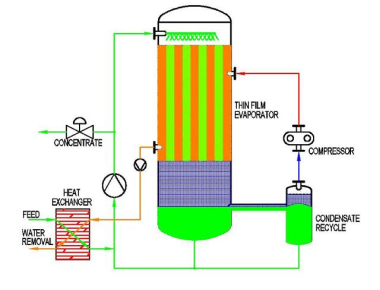
- Feed conditioning: screening/filtration, softening or pH trim; antiscalant for Ca/Mg/Si control.
- MVR falling film (vacuum): VFD compressor sets ΔT; shell vacuum defines boiling point.
- Condensate polishing: filters/RO/AC to reuse or discharge spec (conductivity/TOC guard).
- Crystallization & solids: DTB/OSLO or FC crystallizer -> centrifuge/dryer -> compliant solids discharge.
- Automation: start/stop recipes, load following via VFD, scheduled CIP windows.
- Falling-film evaporator body with film distributors and vapor-liquid separator
- MVR mechanical vapor compressor (turbo/Roots) with VFD for ΔT/capacity control
- Surface condenser, vacuum/NCG handling, preheaters/heat-recovery HX
- PLC/HMI/SCADA; instrumentation (T/P/flow/cond/level) with historian
- CIP skid; antiscalant dosing; optional condensate polishing filters/RO
| Parameter | Typical Range* |
|---|---|
| Operation | Continuous, 24/7 (vacuum duty) |
| Electric use (MVR) | ~15-40 kWh per ton of water evaporated |
| Fresh steam demand | Very low after start-up (backup/ancillary only) |
| Shell pressure | ~6-25 kPa(abs), duty-dependent |
| Turndown | 50-100% with stable ΔT and quality |
| Materials | SS316L / duplex; Ti/Hastelloy on request |
Continous Operation Mode Turbo Mvr Compressor With Customized Voltage
Continuous Operation Mode Turbo MVR Compressor With Customized Voltage MVR System Introduction Mechanical Vapor Recompression (MVR) system works by compressing secondary steam generated by the evaporator using a high-efficiency steam compressor. This process converts electrical energy into thermal ...
Plate-Type Vacuum MVR Evaporator Evaporation Equipment Forced Circulation
Product Description: MVR Evaporator is a multi-effect evaporator designed for seawater desalination. It features a custom-made temperature range, automatic control, and power output that can be tailored to the needs of the user. This evaporator is designed to run in a continuous mode and is ...
Consumption Saving Ti Mvr System For Nacl Evaporative Crystallization
Consumption Saving Ti MVR System For NaCl Evaporative Crystallization The Titanium (Ti) MVR evaporation & crystallization system is purpose-built for table salt and industrial salt. By mechanically recompressing and reusing latent heat, it cuts specific energy use and fresh steam demand while ...
Zero Liquid Discharge Mechanical Recompression Evaporator For Dairy Glucose Organic Acid
Product Description MVR SYSTEM INTRODUCTION Mechanical vaporization re-compression system, which is called MVR which principle is to compress the second steam generated by evaporator by high efficiency steam compressor; this process transfers electric energy to eating energy and higher the pressure ...

